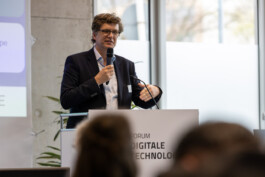
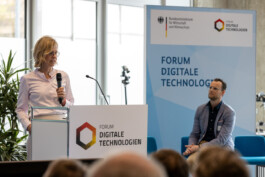
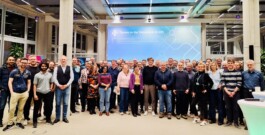
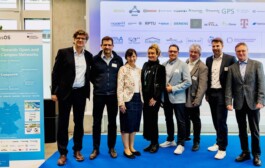
After more than three exciting years of research and development of open and modular 5G campus networks, the big CampusOS final event took place on March 26 with 140 guests at the Fraunhofer Heinrich Hertz Institute.
Together with the 22nd CampusOS partners, the six satellite projects KliNet5G, 5G++Flexicell, O5G-N-IoT, CampusDynA, TICCTEC and MAVERIC as well as the German-French projects in the 5GOpera environment, the most important results from the last few years were presented.
The event was opened by the CampusOS coordinators Slawomir Stanczak & Thomas Magedanz as well as by the BMWK represented by Axel Voss.
The three CampusOS demonstrators TOPCON, STILL und BOSCH Research formed the content-related start. We also discussed the following questions based on the experience and results gathered:
The published white papers and the CampusOS guideline set out what needs to be considered when implementing open and modular 5G campus networks: Campus-OS — Publications.
We would like to take this opportunity to thank our speakers and moderators:
Erich Zielinski, Raimo Vollstädt, Frank Hofmann, Julius Schulz-Zander, Björn Richerzhagen, Matthias Tammen, Oscar Dario Ramos Cantor, Leszek Raschkowski, Florian Zeiger, Björn Richerzhagen, Elena Kempf-Loeck, Dario Götz, Eckhard Oppermann, Sybille Hupfeld, Stefan Richter, Bernd Schröder, Stephan Ludwig, Ernst Joachim Steffens,Tobias Pabst, Martin Mailand, Maximilian Daniel, Horst Hellbrück, Martin Seidel und Stefan Senk.
Another highlight of the event was an exhibition with 30. Technology Live Demonstrators. In the afternoon, the satellite projects and 5G-OPERA presented their results.
The event continued with a look into the future - and the announcement that the results from CampusOS, which has laid the foundations for an ecosystem for open and modular campus networks in Germany and Europe over the last three years, will be continued in the xG-ALOE initiative.
Overall, the initiative aims to create and further develop a sustainable and innovative ecosystem for open and modular private 5G and 6G networks. The focus is on both the technology provider side and users from all vertical market segments in order to enable their mobile application scenarios. Ecosystem players can use the xG-ALOE initiative as a source of information and to exchange experiences on requirements, scenarios and quality standards for 5G campus networks.
If you would like to become part of the ecosystem, please contact us: xg-ALOE — Ecosystem
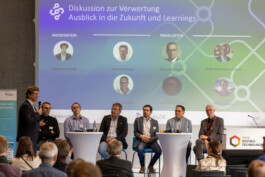
The day will conclude with an expert panel moderated by Slawomir Stanczak with the panelists: Ansgar Bergmann, Raimo Vollstädt, Oscar Ramos Cantor, Thomas Höschele, Thomas Magedanz and Ernst-Joachim Steffens- on perpetuation, an outlook into the future & learnings from recent years.
As it was (unfortunately) the end of the project, we are especially grateful for the cooperation and support of our partners who made CampusOS a valuable success: Atesio GmbH, BISDN GmbH, Bosch, brown-iposs GmbH, EANTC AG, GPS GmbH Stuttgart, highstreet technologies, Kubermatic , Node-H GmbH, MUGLER SE, RT Solutions, Rohde & Schwarz, Siemens, Smart Mobile Labs, STILL, SysEleven GmbH, Deutsche Telekom, Topcon Positioning Systems, Technische Universität Berlin, Rheinland-Pfälzische Technische Universität Kaiserslautern-Landau (RPTU)
Special thanks also go to the Bundesministerium für Wirtschaft und Klimaschutz for funding the CampusOS project and in particular to Axel Voss, Dr. Klaus Glasmacher and Dr. Walter Mattauch as well as Dr. Sabine Hemmerling and Kai Sandmann from DLR-PT for their support.